
The main objective of this project is to assess the application of pruning fully mechanised in the olive crop, determining its effectiveness in optimising vegetative growth and production in both intensive and traditional olive groves. The aim is therefore to compare this system with the conventional pruning system using a chainsaw, at agronomic, productive and economic levels.
The project duration is from January 2025 to May 2026, although it includes studying the 2024 and 2026 seasons.
Objectives
The specific objectives of this project are:
• To have several field trials where, under real conditions, the adaptation of olive cultivation in the areas of Baix Camp, Terra Alta and Baix Ebre – Montsià and the varieties arbequina, empeltre and morruda can be studied under different pruning practices (manual vs fully mechanised).
• To quantify the effect of mechanical and manual pruning on the water status and transpiration of the different olive varieties through innovative remote-sensing technologies.
• To quantify the effect on the vegetative, productive and economic performance and the sustainability of the fully mechanised pruning system compared with the manual pruning system using a chainsaw.
• To improve the profitability of plantations by reducing labour costs and the time invested.
Increase oil production per area by reducing the period of alternate bearing.
• To optimise the flow of information and organise efficient communication with companies and producers in areas with olive-oil activities (both in Catalonia and other European regions).
Participating cooperatives
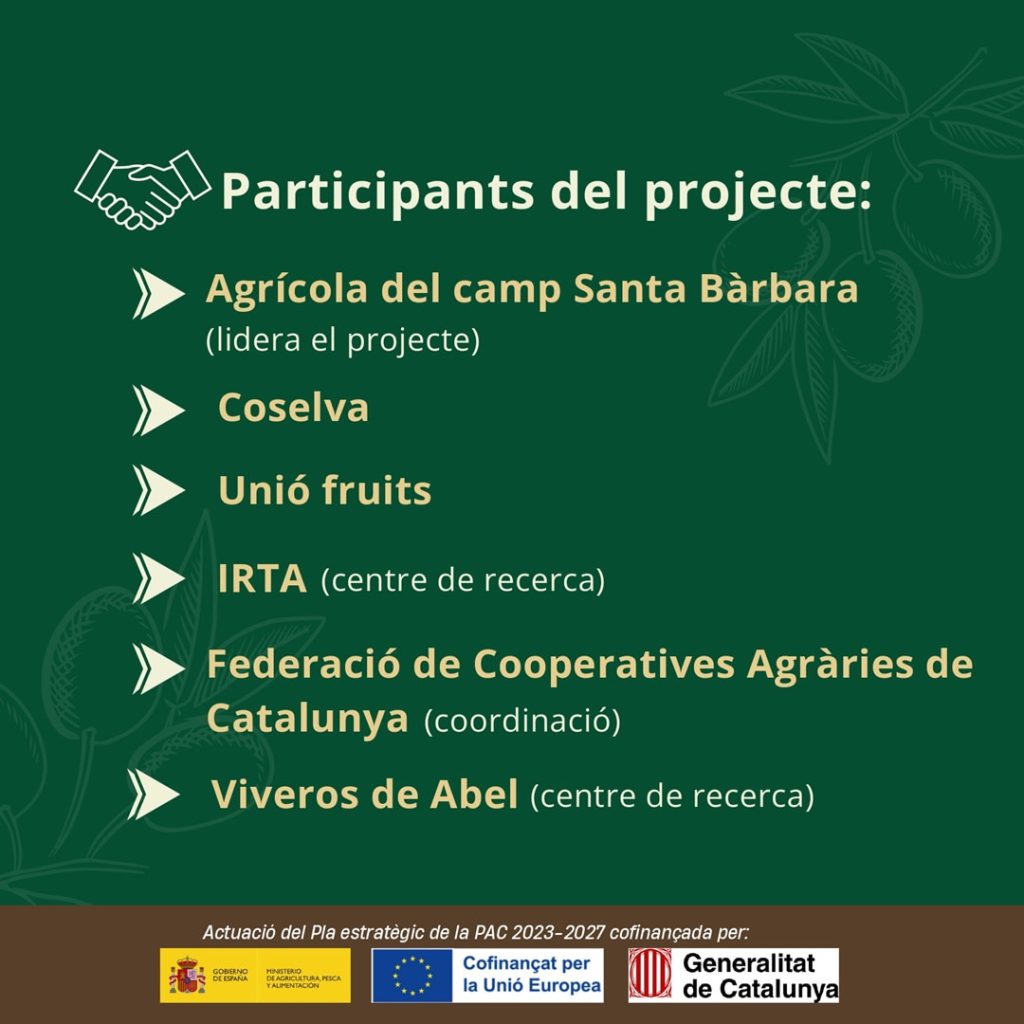
Agrícola del Campo Santa Bárbara, as leader of the Operational Group, COSELVA and Unió Fruits.
Project partners
In addition to the participating cooperatives, the project partners are the Federation of Agricultural Cooperatives of Catalonia, acting as coordinator of the operational group; the Institute of Agrifood Research and Technology (IRTA), as the research centre; and the company Viveros de Abel, which is not a member of the Operational Group but will support certain activities.
Expected results
• To have 3 demonstration farms for mechanical pruning that will enable its study for possible extrapolation to other farms and holdings in the different areas.
• To determine, under real field conditions, the olive yield through different pruning practices (mechanised vs manual).
• To have information on the carbon footprint and the sustainability indices of each pruning system.
• To have objective data on the feasibility and limitations of the methodology in order to recommend the fully mechanised pruning technique.
• To obtain an assessment of the water-response of each variety.
• To make available to farmers the data and results that can be consulted online. data and results available for online consultation.
Action under the CAP Strategic Plan 2023–2027 co-financed by:
 |
 |
 |